
Buyer's Guide: Choosing the Right Artificial Hydrangea for Events
FSARCAN ·
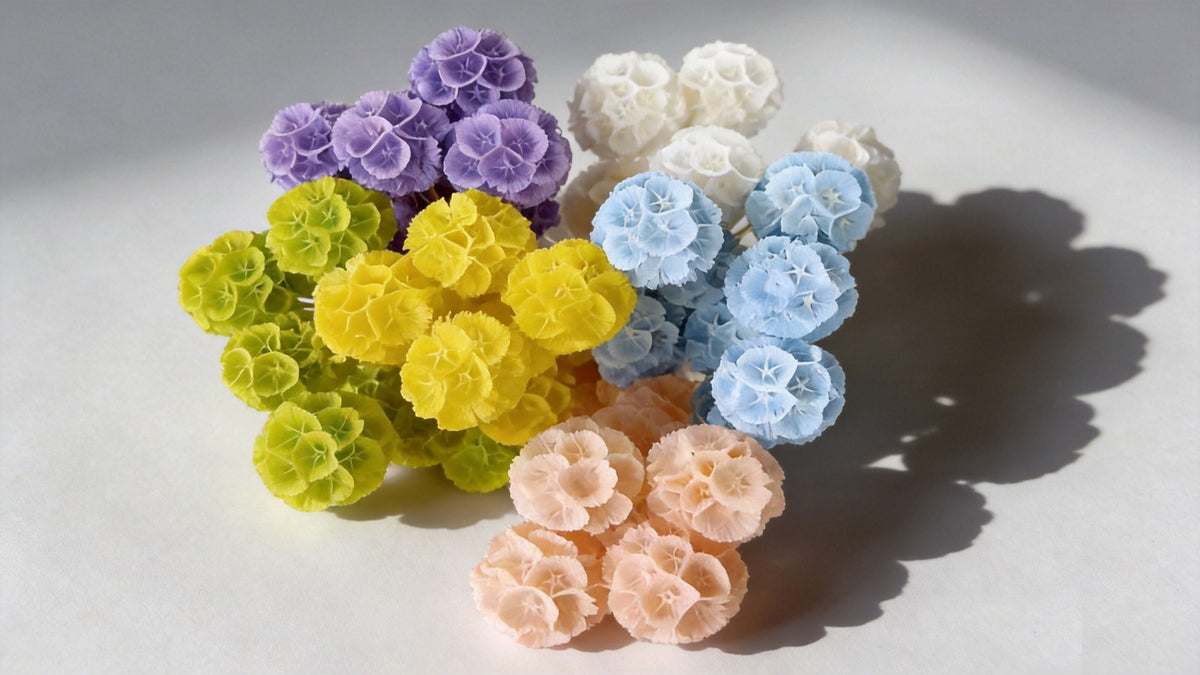
Artificial hydrangea-style flowers are useful volume builders for weddings, retail displays, rental inventory, and large event installations. But bulk buyers still need to compare construction, head count, scale, color consistency, and total landed cost before choosing a model.
This guide uses FSARCAN's 4-head windmill fruit artificial hydrangea as the main example and contrasts it with the 54-triangle-petal flower head where the comparison is useful.
Decision 1: Choose the Petal Style
Windmill Fruit Style
The windmill-style clusters create a more open, graphic pattern than a conventional rounded hydrangea head. They work well in table arrangements, editorial bouquets, colorful installations, and designs where individual details will be viewed at close range.
Triangle Petal Style
Triangle petals build a denser, more familiar rounded silhouette. This style is practical for arches, backdrops, urns, and other applications where the buyer needs broad coverage rather than a distinctive focal texture.

Decision 2: Compare the Selling Unit
Head counts are not interchangeable across listings. One SKU may be sold as a complete multi-head stem, while another may be a single detachable flower head. Before comparing unit prices, confirm exactly what one unit includes.
| Configuration | Typical use | Buyer check |
|---|---|---|
| 1-2 heads | Small accents and compact vessels | Stem length and head diameter |
| 3-4 heads | Centerpieces and medium arrangements | Total spread and stem stiffness |
| 5+ heads or clustered heads | Large urns and installation work | Weight, support, and packing recovery |
| Loose flower heads | Walls, props, garlands, and custom mechanics | Attachment method and back construction |
The 4-head windmill fruit product is a complete stem. The 54-triangle-petal product is listed as a flower head, so its lower unit price should not be compared directly without calculating the number of heads, stems, and mechanics required for the finished design.
Decision 3: Build a Color Plan
- White and ivory: flexible bases for weddings and neutral retail displays.
- Pink and rose: useful for romantic, spring, and layered tonal palettes.
- Blue: suited to cool palettes, coastal themes, and contrast against warm flowers.
- Purple: adds stronger saturation to editorial and seasonal designs.
- Green and yellow: useful for botanical, modern, and high-energy installations.
For bulk orders, approve a physical sample under the venue's lighting. Screen settings, batch variation, and surrounding colors can change how a shade reads.
Decision 4: Check Size and Proportion
Measure the vessel opening, visible vessel height, target arrangement width, and sightline before ordering. A small flower can disappear in a wide urn, while an oversized cluster can block conversation across a dining table.
| Application | What to measure | What to test |
|---|---|---|
| Bud vase | Neck width and stem length | Whether one head feels balanced |
| Low centerpiece | Finished height above tabletop | Guest sightlines across the table |
| Urn | Opening diameter and arrangement spread | Stem support and visual weight |
| Arch or backdrop | Coverage area | Heads required per visible square meter |

Decision 5: Calculate Product Cost Transparently
At the time of publication, the 4-head windmill fruit artificial hydrangea is listed at $0.70 per stem. The table below applies that listed unit price to four example quantities. It does not assume an automatic volume discount.
| Order quantity | Listed unit price | Product subtotal |
|---|---|---|
| 30 stems | $0.70 | $21 |
| 50 stems | $0.70 | $35 |
| 100 stems | $0.70 | $70 |
| 200 stems | $0.70 | $140 |
These are product subtotals only. Freight, duties, taxes, payment fees, samples, packaging requirements, color customization, and installation materials are excluded. Request a current quote to calculate landed cost.

Quality Checklist for a Bulk Sample
- Confirm whether the listing unit is a stem, branch, flower head, bundle, or carton.
- Count the petals or clusters on the physical sample against the specification.
- Inspect cut edges, seams, printing, and color transitions in daylight.
- Bend the stem and confirm that the internal wire holds its position.
- Shake and rotate the sample to check whether heads loosen or spin.
- Compress the sample briefly, then observe how well the bloom recovers after unpacking.
- Photograph the sample with the same lighting and camera setup used for the event or catalog.
Plan for the Finished Installation
Hydrangea-style flowers are strongest when they solve a clear design problem: adding volume, filling mechanics, repeating color, or creating coverage at distance. Combine dense heads with more open flowers and greenery so the final installation retains depth rather than becoming a single block of color.

Buyer FAQ
How many stems should I order for a centerpiece?
There is no reliable universal number because head spread, vessel size, desired density, and companion flowers all change the result. Build one approved sample arrangement, record the exact recipe, and multiply it by the number of tables plus a reasonable replacement allowance.
Can windmill and triangle petal styles be mixed?
Yes. Their contrasting silhouettes can add texture, but first test color compatibility and scale. Use one style as the dominant volume and the other as an accent.
How should artificial hydrangeas be cleaned?
Start with low-pressure cool air or a soft brush. Test any damp-cleaning method on a hidden petal and let the sample dry fully before repacking.
Should I compare products by unit price?
Only after normalizing the selling unit. Compare the cost of the finished coverage or recipe, including stems, loose heads, mechanics, freight, and labor.
Review the 4-head windmill fruit artificial hydrangea, compare the 54-triangle-petal flower head, or request a current B2B wholesale quote.