Blue Artificial Flowers: How to Compare Stems and Shades for a Bulk Order
FSARCAN Team ·
Which blue artificial flowers should you buy in bulk? Start with the exact shade, flower shape and finished display size, then compare the product references in the same lighting. A “blue” rose, a “light blue” delphinium and a “royal blue” peony are separate catalogue variants; their colour names do not establish that they match. Request samples where colour is critical, count complete stems in one approved design and ask for a written quote.
This guide is for florists, event teams and retailers choosing blue artificial flower stems for a range or project. FSARCAN supplies listed flower products from mainland China by enquiry. The references below are loose flower products, not a ready-made bouquet, a UK-stock promise or a guarantee that a requested shade is available.
Start with the blue you need
“Blue” can mean anything from a pale accent beside white flowers to a strong saturated focal colour. Rather than relying on a colour name alone, send the supplier a photograph of the intended palette or details of a physical swatch. Say what the flowers must sit beside: a bridesmaid fabric, existing artificial stems, packaging, a vessel or a brand-colour reference.
If a close match matters, place labelled samples next to that reference in daylight and in the lighting planned for the shop or venue. Photograph the samples together with their codes visible, but keep the physical reference for the final decision: screens and camera settings can change apparent colour. Ask before accepting a substitute.
Looking for navy or dusty blue? Use those words to describe the target, but ask which exact current variant is closest and request evidence of the shade. The names in the table are the catalogue labels, not a claim that any of them is an exact navy or dusty-blue match.
Compare five blue flower references
The specifications and colour-specific codes below were checked against FSARCAN's catalogue on 12 November 2026. Listed variants identify products to discuss; availability, samples, quoted units and delivery are confirmed for the individual enquiry.
| Catalogue reference | Listed details | What to compare |
|---|---|---|
| FA-059-05 Light Blue / FA-059-06 Deep Blue | Two-branch delphinium; 86 cm total length; about 48 cm above the branching point; fabric and plastic label. | Compare the two named colour options and check the visible height in the chosen vessel. |
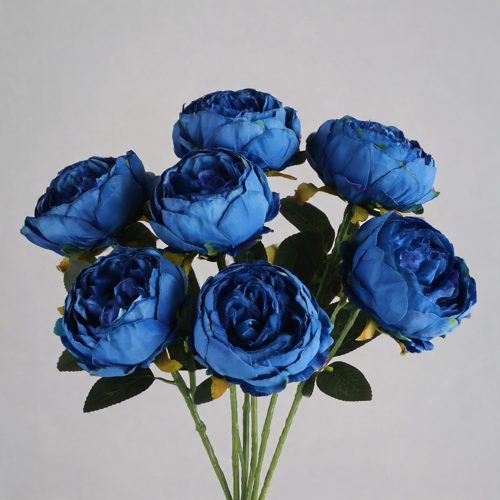
| FA-040-01 Royal Blue | Seven-bloom cupped peony; 44 cm total length; listed flower-head measure 9 cm; fabric. | Check the flower-head shape, the whole quoted unit and its spread after unpacking. |
| FA-045-01 Sky Blue / FA-045-04 Pale Blue | Nine-bloom Phalaenopsis orchid; 70 cm total length; fabric. | Request the exact variant and compare its colour and curved form in the display. |
| FA-084-07 Blue | Gerbera daisy; 43 cm total length; 9 cm listed flower head; fabric petals. | Compare the open daisy shape and head scale with the other selected flowers. |
| FA-065-07 Blue | Baby's breath stem; 60 cm total length; injection-moulded plastic label. | Check the fine details, stem colour and visual contribution from the intended distance. |
Check how each flower-head measurement is taken if a precise opening or design dimension depends on it. A photograph may show several stems together. A seven-bloom product name does not mean that seven individual stems are included in the quoted unit.

Choose the form as well as the shade
A long delphinium branch and a shorter cupped peony can play different roles even when both are described as blue. For a taller entrance vase, compare the 86 cm FA-059 with the vase depth and the height you want visible. For a lower table piece, check whether the 44 cm FA-040 and its flower arrangement fit the intended vessel. These are starting points for testing, not a claim that either item is suited to every vase.
For a retail range, keep a separate line for each flower and colour. A customer looking for a pale accent may not accept a saturated blue as a substitute. If the design uses white or ivory too, compare the actual pieces together; our white artificial flower guide covers how to approve those shades.

Calculate quantities from one approved design
Count the complete product units used in each type of arrangement, not the number of petals or the flower heads visible in a photograph. For example, suppose a buyer approves a hypothetical table design using two complete FA-040 Royal Blue units and three complete FA-065 Blue stems. For 15 identical tables, the starting enquiry would be 30 FA-040 units and 45 FA-065 stems. Decide any spares separately.
That is an arithmetic example, not a claim that the products have been assembled together, that their blue shades match or that this recipe gives a particular fullness. Ask the supplier to confirm the sales unit and pack quantity for each colour. Recalculate if the vase, design or product changes.
Compare a UK order on the same delivery basis
A buyer comparing a UK-stocked product with a quotation from mainland China should compare the same product format, colour and quantity first. Then list product cost, packing, freight to the named destination, estimated timing and exclusions separately. Clarify who handles import clearance, duties and taxes for the actual transaction. The UK buyer's guide to sourcing from China explains the questions to ask. If you are responsible for importing, consult the UK government import guide and confirm how the requirements apply to the actual shipment.
For an event or public venue, check the venue's requirements before specifying an installation. Do not assume that a product is fire-rated, weatherproof or suitable for a particular outdoor location from its colour or product image. Ask for product-specific information and evidence where needed.
What to include in your blue flower enquiry
- The product link and colour-specific code, or a clear reference photo if you need help finding a similar flower.
- The shade that must match and any acceptable alternatives; include swatch details when available.
- The number of complete stems or product units needed for each colour and style.
- The intended use, approximate finished dimensions, destination country and postcode, and required arrival date.
- Questions about sample availability, quoted units, packing, timing and freight scope.
We are considering FA-059-05 Light Blue and FA-045-04 Pale Blue for a floral display. Please confirm whether each reference and colour can be supplied, what one quoted unit contains, and whether samples are available. Our provisional quantities are [quantity of each], for delivery to [country and postcode] by [date]. We will send our colour reference by email or WhatsApp. Please tell us about any proposed alternative before quoting it.
Send FSARCAN your product list or sourcing brief. The contact form does not upload images; use the email or WhatsApp options on the contact page for photographs. For a reference without a known code, see how to request a quote or find a similar product.
Frequently asked questions
Are light blue, pale blue and royal blue artificial flowers the same shade?
No. The words identify the colours listed for particular products; they do not establish a standard shade across different styles or suppliers. Compare the exact variants against your reference under the intended lighting.
Does a blue silk flower contain silk fibre?
“Silk flowers” is commonly used as a shopping term for artificial flowers. The examples in this guide have different listed materials and finishes; ask about the exact construction if fibre content is important.
Can I ask for blue flowers in mixed styles and quantities?
Yes. List each code, colour and quantity separately, then ask whether the requested mix, pack sizes and delivery can be supplied. Confirm the final details in the written quotation.