
How to Make an Artificial Flower Garland: A Wholesale Stem Guide
FSARCAN Team ·
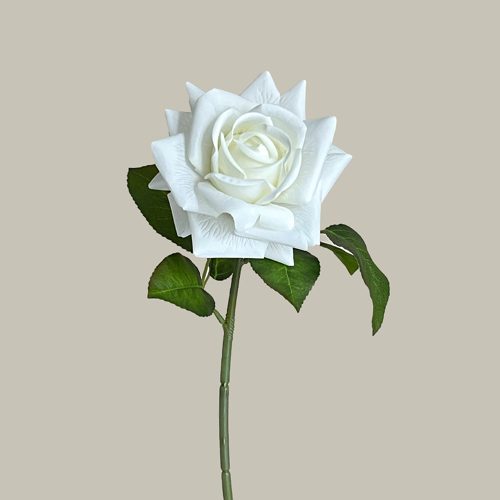
How do you make an artificial flower garland? Decide where it will go and how long it needs to be. Test your chosen flowers and foliage on a short section of the intended base, then repeat the approved design along the measured length. Count complete flower units by reference and colour before asking for a bulk quote.
This guide is for florists and event teams planning to assemble a floral garland from loose materials. FSARCAN supplies artificial flowers and foliage by enquiry from mainland China. The catalogue references below are individual flower or foliage products; they are not a ready-made garland, support, installation service or UK hire stock.
Choose the type of garland before buying
A loose strand of small flower clusters looks different from a full table runner or a swag fixed to an arch. Decide which sides will be visible, whether the garland needs to curve or drop, and who will provide and attach the base. Measure the actual path rather than just the straight-line gap between two ends; a draped line is longer than the distance between its supports.
| Use | Measure | Check in a sample |
|---|---|---|
| Table runner | Table length, clear space for plates and sightlines | Width and height from a seated position; who supplies the base |
| Arch or doorway swag | The decorated path, mounting positions and desired drop | Density at curves and corners; permission and suitable fixings |
| Hanging flower strand | Length between approved supports and desired depth | Spacing of clusters and the effect of the weight on the support |
These are planning categories, not interchangeable recipes. A strand of spaced mini-bouquets needs a different count from a dense foliage runner of the same length.
What do you need to make a flower garland?
Prepare the chosen flower and foliage samples, a tape measure, a suitable base and the attachment materials your florist or installer has selected for that base. The IKEA UK example uses small tied flower clusters suspended from a line; it is one home-display method, not a specification for a commercial venue. Ask the venue or installer to approve the support and attachment method for your own setting.
Check the exact products before cutting, bending, wiring or gluing them. Internal wire, petal materials and finish differ by reference; ask the supplier how the item can be handled and use suitable tools. Do not assume a glue, fixing or modification is suitable for every product.
Choose stems for a sample, not just a photo
The following FSARCAN catalogue references were checked on 14 November 2026. They illustrate different product forms; they have not been assembled together for this guide. Product photos can show more than one stem. Confirm what a quoted sales unit contains and ask whether samples are available.
| Catalogue reference | Listed detail | What to test |
|---|---|---|
| FA-003-01 White rose | 42 cm overall length; 12 cm listed flower-head measurement; real-touch finish label. | Does the head size fit the desired focal position and spacing? |
| FA-075-05 Green asparagus fern branch | 70 cm overall length with a listed 50 cm foliage section; plastic. | How much of the branch remains visible on the intended base? |
| FA-065-06 White / Green Stem baby's breath | 60 cm overall length; injection-moulded plastic label. | Does the branch give the scale of detail you want between focal blooms? |

Compare actual samples with each other and with the table linen, backdrop or ribbon in the intended light. Similar colour names do not guarantee a match. The product's total length is not the same as the length it will cover once positioned or attached.
Make a representative sample section
- Mark the base. Measure a short section that represents the main, repeated part of the design. Use the same type of base and planned attachment method as the final piece.
- Place the focal flowers. Arrange them at the intended spacing and angle. Look from the front and from the normal guest or camera distance.
- Add supporting flowers and foliage. Adjust the visible width and fullness without assuming that a particular product covers a fixed distance.
- Check the join. Place a second trial section beside the first or mark how they would overlap. Measure the effective repeated length, not just the raw length of the unjoined piece.
- Record the approved sample. Photograph it, note its measured effective length and count complete physical units by exact product and colour. Ask the supplier how those units map to the quoted selling and packing units.
For a suspended piece, the venue and responsible installer should assess the load, supports and fixings. A photographed sample does not establish that a longer installation is safe to hang.
How many stems do you need for a garland?
There is no fixed number of stems per metre. Count the units in an approved, measured sample and scale only the sections that use the same design. Treat fuller ends, changes of direction and any additional pieces separately.
Illustrative calculation: suppose the decorated path is 3 m long and a repeatable sample, measured after allowing for its join, covers 0.5 m. Six equivalent sections would cover the path. If each hypothetical section used two FA-003-01 rose units, one FA-075-05 fern unit and one FA-065-06 baby's breath unit, the starting list would be 12 roses, six fern branches and six baby's breath units. Add any different end treatments or separately chosen spares afterwards.
This is arithmetic for an imagined design, not a physically tested arrangement, coverage promise or minimum order. It works only if the repeated sections are genuinely equivalent and the installer confirms the design is workable. If the supplier quotes in packs, check the pack size and round each product and colour separately where required. For a worked comparison of packs, see the flower bunch buying-units guide.

Check venue rules, outdoor use and assembly scope
For a commercial venue, involve the venue's responsible person and installer in the planning. Kent Fire and Rescue Service advises considering artificial foliage in the fire risk assessment and keeping it away from heat sources and fire-protection systems. Requirements vary by venue and location. Ask what evidence is needed for each exact product and component; FSARCAN has not confirmed fire-performance certification for the examples above.
Do not assume a garland is suitable outdoors, UV resistant or weatherproof because the flowers are artificial. Ask about the actual items and conditions. Check placement, access, fixings and handling with the venue. The frame, base, attachment materials, local assembly and installation are separate from a loose-stem enquiry unless the written quote specifically includes them.
Request a bulk flower quote for your garland
Send a sketch or reference photo, the measured decorated length and desired width, exact product and colour codes, and the complete units needed for each reference. Include the destination country and postcode, required arrival date, and any sample or packing questions. Ask for availability, selling units, minimum quantities, shipping and the quoted scope to be confirmed in writing.
We are planning [number] garlands for [type of display]. Each decorated path is approximately [length] with a target width of [width]. We would like to compare FA-003-01 White, FA-075-05 Green and FA-065-06 White / Green Stem. Our provisional quantities are [units by reference], subject to sample approval. Please confirm the unit contents, sample options, availability, packing, timing and delivery scope to [UK postcode] by [date].
Send your flower-material enquiry to FSARCAN. To share a photo, use the email or WhatsApp option shown on the contact page; the web form does not accept attachments. For arch-specific planning, see the wedding arch flower guide. To compare flower shape and finish, use the artificial arrangement planning guide.
Frequently asked questions
Can I buy a ready-made artificial garland from FSARCAN?
The references in this guide are individual catalogue flowers or foliage, not a finished garland. If you need an assembled product, send a photo and specifications and ask whether it can be sourced; availability and scope need confirmation.
How long should the garland base be?
Measure the intended decorated path, including curves or drapes, and discuss the fixing points and any overlap with the installer. A straight-line measurement between the ends can be too short for a draped design.
Can the same flower count be used for every metre?
Only as a provisional calculation for equivalent repeated sections after the sample is approved. Different density, corners, ends or visible sides need their own count.